IABA is recruiting an Ulster Operations Manager on a maternity cover contract. This is a high responsibility role, working in collaboration with Ulster Boxing Council and the County Antrim Board, with the strategic focus on improving and developing boxing within Ulster.
Job Purpose: The post-holder will oversee all operations of the IABA Ulster Branch, with the strategic focus on improving and developing boxing within Ulster. The role will work closely with the Ulster Boxing Council and the County Antrim Board, whilst reporting to the IABA. The post will be responsible for the implementation of the IABA Strategic Plan and the Ulster Boxing Council’s Strategy, while also continuing to deliver recommendations of the report of the Independent Working Group Examining Boxing in Ulster. The post will be responsible for all financial, staff and governance management within the Branch and provide governance support to the IABA. The post-holder will seek a variety of funding and other sponsorship and revenue sources to support and increase service development within Ulster. The IABA is seeking an experienced manager to lead the IABA Ulster Branch operations. The person will be highly organised with the ability to multi-task and manage their time in a highly efficient manner. You will also have a high level of verbal, written and inter-personal communication skills. You will have experience in managing people, resources, budgets and have experience in organising and administering good governance practices. This post is a maternity cover contract until up to 31st July 2025, with the possibility of extension, subject to continuation of funding.
Applications
To apply please send your CV and a Cover Letter to HR@iaba.ie. Closing date Wednesday 17th July at 8pm. The IABA is an Equal Opportunities employer.
Team Ireland has concluded a 13-day pre-Paris training camp in the German Olympic Training Centre in Saarbrucken today, and are en route home.
The 10 strong team, the largest Team Ireland Boxing Team since Rome of 1960, trained with the hosts, USA, India, Cuba, Mongolia, Nigeria, Australia, Philippines, Sweden and Belgium.
The camp took place less than 2 hours drive from the French women’s camp. To take advantage of that, and expand the pool of sparring partners, the women’s squad travelled there for sparring on July 8th, and the men on July 11th – facilitating sparring with France, Turkey, Ecuador and Uzbekistan.
The team will have light training over the next couple of days, and spend time with family, and reconvene at the weekend. They depart for Paris on Monday.
Boxing is Ireland’s most successful Olympic sport, boasting 18 of our 38 medals – and Team Ireland Paris 2024 is one of only three countries in the world to have qualified women at all 6 Olympic weights. That’s a remarkable achievement, given this is only the 4th Olympiad at which women may box.
Last day of training in Saarbrucken for @TeamIreland Boxing. The best experiences in life are those you never imagine or plan for. Something very special about this sport and the @IABABOXING tribe… 🇮🇪💚🥊🏹 pic.twitter.com/BMyENWUKgp
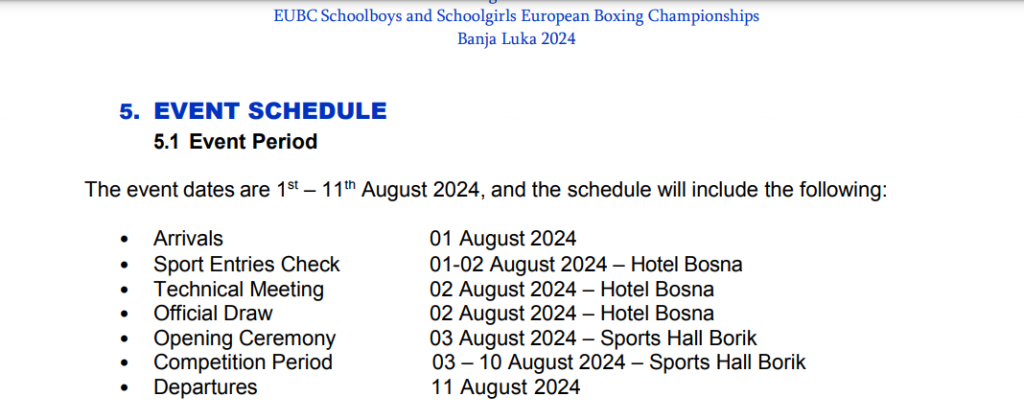
29 boxers have been named in the Team Ireland team to contest the 2024 European Championships, taking place in Banja Luka, Bosnia & Herzegovina from August 1st to 10th.
The upcoming championships will be the 21st iteration of this tournament. The first Europeans, for male boxers 13 and 14 years old, was held in Rome, Italy in 2003. The most successful team was Turkey, who went home with six gold medals. Second place went to Russia, with three champions, while Ireland, Italy, Azerbaijan and England had one gold medal each.
The first EUBC Schoolgirls European Boxing Championships was held in Albena, Bulgaria in 2018. Fifteen years after the inaugural Schoolboys Championships, 12 girls were crowned European Champions. They fought in weight categories between 36 and 70 kilograms. The best girls’ team was Russia, with six gold medals, Ireland won three gold medals, while Bulgaria, Italy and England had one champion each.
Team Ireland came home from the 2023 European School Championships in Slovenia with 3 gold, 1 silver and 7 bronze medal – along with the 3rd place finish in the medals table. 32 federations competed in the tournament. In all, 380 boxers contested the tournament. Ukraine topped the medals table with 20, followed by England, with 12. Team Ireland had the largest women’s team, of 12 boxers, and the joint second-largest men’s team, of 14 boxers.
St. Catherine’s Boxing Club in Dublin 8 hosted several dignitaries today, and shared the impact of their club’s work on the local community
Édouard Philippe, former Prime Minister of France and current Mayor of Le Havre, is on a visit to Ireland. Mr. Philippe is an accomplished boxer who trains twice weekly. While visiting Ireland he was keen to maintain his training schedule and the St. Catherine’s Boxing Club was happy to oblige.
Mr. Philippe was joined by the French Ambassador Vincent Guéren, the Lord Mayor of Dublin, James Geoghegan and Gaultier Brand-Gazeau, Head of the Economic Department of the French Embassy. All three, despite being novices, took part in training.
Members of the St. Catherine’s Club outlined to the dignitaries their work and that of other sports groups in the southwest inner city to involve kids in sporting activities and explained some of the problems, particularly the absence of even a single outdoor football, GAA, or rugby pitch in an area containing thousands of young people.
All were agreed on the importance of involving young people in sport and the necessity of facilities being provided to support this.
Its 12 days to the first bell at Paris 2024 – and we continue our celebration of the Olympic centenary of Irish boxing, by revisiting Montreal 1976
Brendan Dunne has the distinction of being the first Irish light-flyweight to compete at the Olympic Games. AIBA introduced the light-flyweight class at the Mexico City Games in 1968, and Dunne, of the Phoenix BC in Dublin, wore the Irish 48kg vest in the lightest of the weight categories in Canada eight years later. The three-time Irish Elite champion, father of Irish champion and former European and WBA World title holder Bernard Dunne, made an impressive start in Montreal after stopping Asian Games silver medalist Noburu Uchiyama of Japan in round two at the Aréna Maurice Richard, an ice hockey revamped for boxing. But the Dubliner was then beaten by eventual bronze medalist, Orlando Maldonado of Puerto Rico, in the last-16 stage.
Belfast’s Davy Lamour, who, along with 1972 Olympian John Rogers, lined out for Ireland at the inaugural AIBA World Men’s Championships in Havana, Cuba in 1974 was drawn against Robert Masuka (Swaziland) and Augustin Martinez (Nicaragua) in Montreal. However, Lamour received walkovers, although Martinez wouldn’t have been allowed box anyway after it was discovered he was just 16-years-old, one year shy of the minimum age requirement. It’s probable that Martinez was barred because he was underage, while Swaziland, although not listed, appears to have been one of the numerous African nations who boycotted the Games because of New Zealand’s sporting (rugby) ties with South Africa which was banned from the Olympics because of apartheid. Either way, the Shankill flyweight, a gold medal winner for Northern Ireland at the 1974 Commonwealth Games in Christchurch, New Zealand, got byes straight into the last-eight where he was lost on points by Leo Randolph of the USA, who went on to win gold.
Gerry Hamill, Christy McLoughlin and Brian Byrne also represented Ireland in Montreal, but all three went out at the first phase of the competition, Hamill losing out to the aptly named Ace Rusevski of Yugoslavia, who took home a bronze medal from the Games. Hamill, the 1978 Commonwealth champion, looking back on his defeat to Rusevski, had a few words of advice for young boxers – and the older ones as well. “In 1976, I made the mistake of not listening to Gerry Storey as he had told me exactly how to handle Rusevski. I was fighting the wrong fight and not keeping him at the end of my left hand and at distance and that was to cost me in the end. The most important thing I tell my lads today is to listen to your corner and I know that all too well.”
The USA boxing team, which included the talents of Sugar Ray Leonard and brothers Leon and Michael Spinks, helped America to five gold, one silver and one bronze to finish on top of the medals table in Montreal. Leon Spinks would go on to beat Muhammad Ali for the WBC/WBA World heavyweight titles in Las Vegas in 1978. However, he was stripped of the WBC belt because he didn’t defend it against the mandatory challenger, Ken Norton, and Ali won the rematch (for the WBA title) between the 1960 and 1976 Olympic champions in New Orleans. Cuba finished second in the medals table at the 1976 Games.
Light-flyweight: Brendan Dunne (Phoenix)
Beat Noburu Uchiyama (Japan) TKO2 Lost to eventual bronze medalist Orlando Maldonado (Puerto Rico) TKO1
Flyweight: Davy Larmour (Albert Foundry) Beat Robert Masuku (Swaziland) W/O Beat Augustin Martinez (Nicaragua) W/O Lost to eventual gold medalist Leo Randolph (USA) 1-4
Lightweight: Gerry Hamill (Holy Family) Lost to eventual bronze medalist Ace Rusevski (Yugoslavia) 1-4
Welterweight: Christy McLoughlin (British Rail) Lost to Colin Jones (Great Britain) 0-5
Light-middleweight: Brian Byrne (Transport) Lost to Wilfredo Guzman (Puerto Rico) 2-3
Check out the highlights of the Games here:
There was a desire by the IOC’s program commission to reduce the number of competitors and a number of recommendations were put to the IOC’s executive board on February 23, 1973, which were all accepted. Rowing was the only sport where the number of competitors was increased, and women were admitted for the first time in Olympic history. The 1976 Summer Olympic program featured 196 events with 198 medal ceremonies in 21 sports
The African Boycott
The 1976 Montreal Games were impacted by an African boycott involving 22 countries. The boycott was organised by Tanzania to protest the fact that the New Zealand rugby team had toured Apartheid South Africa and that New Zealand was scheduled to compete in the Olympic Games.
Debuts and Firsts
Women’s events in basketball, rowing and team handball all made their Olympic debut. Hockey was played on an artificial pitch for the first time.
Memorable Champions
Alberto Juantorena of Cuba completed the first 400m and 800m double victory. The Japanese women’s volleyball team proved untouchable, winning all their matches in straight sets, and Miklos Németh of Hungary won the javelin to become the first son of an athletics gold medalist to win a gold of his own.
Perfect Nadia
Fourteen-year-old gymnast Nadia Comaneci of Romania was the undoubted star of the Games. She shot to fame when, for her performance on the uneven bars, she was awarded the first-ever perfect score of 10.0. She went on to earn seven maximum marks in total.